The real history behind the name

The Pirate Hunter Origin Story

Justin Myers • USS Ashland • Gulf of Aden • April 10, 2010

The name “Pirate Hunter” is rooted in Justin Myers’ U.S. Navy service and a documented maritime engagement aboard USS Ashland (LSD 48) in the Gulf of Aden.

On April 10, 2010, USS Ashland came under fire from a skiff manned by suspected pirates while conducting maritime security operations. Justin Myers was serving aboard Ashland as a Gunner’s Mate Third Class (Surface Warfare).

His official Department of the Navy award citation documents his role during the rapidly developing encounter. The event later informed the identity, leadership philosophy, and name behind Pirate Hunter Enterprises.

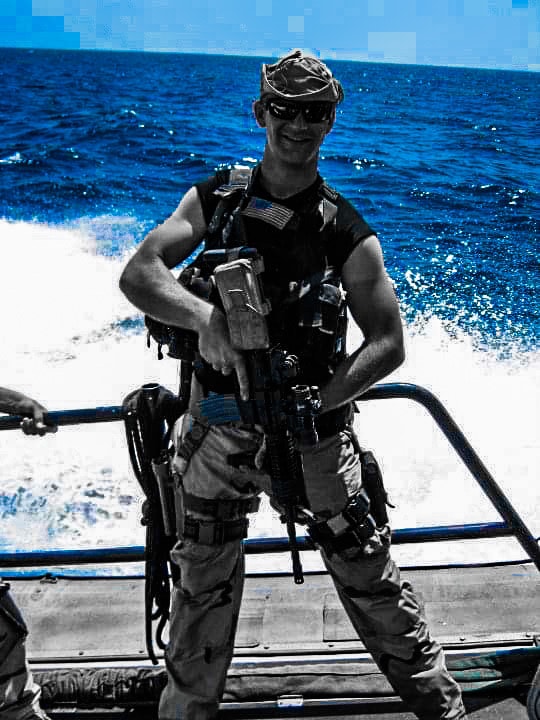
Justin Myers during U.S. Navy service

Documented history

April 10, 2010 — USS Ashland Comes Under Fire

According to official U.S. military records, at approximately 5:00 a.m. local time, USS Ashland was operating in the Gulf of Aden when a skiff manned by suspected pirates fired on the ship.

The U.S. Navy reported that Ashland received small-arms fire on its port side from a six-man crew aboard the skiff. Operating under its rules of engagement, Ashland returned fire. The Navy reported that USS Ashland fired two rounds from its MK-38 Mod 2 25mm gun.

The skiff caught fire and the suspected pirates abandoned it. Ashland deployed rigid-hull inflatable boats to assist the men in the water. After it was verified they no longer had weapons on their persons, all six were brought aboard USS Ashland and received medical care.

Official reporting stated that USS Ashland suffered no apparent damage and no members of the ship’s crew were injured.

Before “Pirate Hunter” Became a Brand

Long before Pirate Hunter Enterprises became a business ecosystem, the words “Pirate Hunter” were connected to a very different chapter of Justin Myers’ life.

Justin served in the United States Navy as a Gunner’s Mate. In 2010, he was assigned to USS Ashland (LSD 48), a Whidbey Island-class dock landing ship operating with U.S. naval forces in the region surrounding the Gulf of Aden.

The waters off the Horn of Africa were then a major focus of international maritime security efforts because of piracy and attacks on commercial vessels. On April 10, 2010, that mission became personal.

Justin Myers’ Role During the Engagement

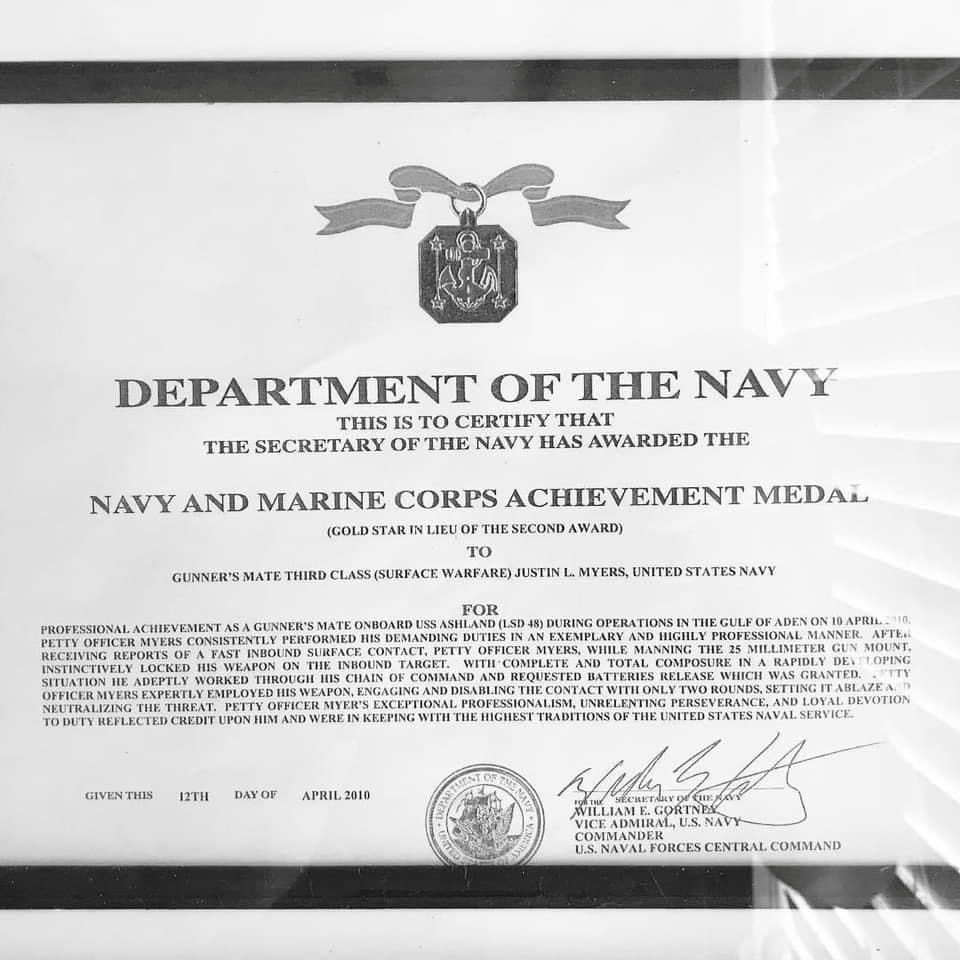
Justin Myers’ official Department of the Navy citation provides a personal record of what occurred at his gun mount. The citation identifies him as Gunner’s Mate Third Class (Surface Warfare) Justin L. Myers, United States Navy, and recognizes his professional achievement aboard USS Ashland during operations in the Gulf of Aden on April 10, 2010.

According to the citation, after reports of a fast inbound surface contact, Myers was manning the ship’s 25-millimeter gun mount. It records that he locked onto the inbound target, worked through his chain of command, and requested batteries release.

Once authorization was granted, the citation credits him with employing the weapon, engaging and disabling the contact with two rounds, setting it ablaze, and neutralizing the threat. The document praises his professionalism, perseverance, and devotion to duty.

Recognized by the Department of the Navy

For his professional achievement during the incident, Justin Myers received the Navy and Marine Corps Achievement Medal.

The supplied award certificate identifies the recognition as the Navy and Marine Corps Achievement Medal, Gold Star in lieu of the second award. It was issued to Gunner’s Mate Third Class (Surface Warfare) Justin L. Myers, United States Navy, and dated April 12, 2010.

Department of the Navy award citation for Justin L. Myers following operations aboard USS Ashland in the Gulf of Aden in April 2010
Official Department of the Navy citation awarding Justin L. Myers the Navy and Marine Corps Achievement Medal for professional achievement aboard USS Ashland during operations in the Gulf of Aden on April 10, 2010.

Lessons Carried From the Gulf of Aden Into Business

Military operations and business are not the same environment. But some leadership principles translate.

Understand the Mission

People make better decisions when they understand the objective, the constraints, and what success requires.

Remain Composed Under Pressure

Fast-moving conditions punish panic. Leaders must process information and continue functioning when circumstances change.

Respect the Chain of Authority

The award citation records Myers working through his chain of command and requesting authorization before engaging. Discipline and authority matter when consequences are real.

Prepare Before the Moment Arrives

Performance under pressure is built long before the pressure appears. Training, repetition, systems, and standards create the foundation for execution.

Execute When Action Is Required

Analysis has value, but leadership eventually requires action. Once the mission is understood and authority is established, someone still has to execute.

Take Responsibility for What Comes Next

Leadership does not end when the immediate problem ends. Teams still have to assess, adapt, care for people, learn, and continue the mission.

Those lessons now influence the way Justin approaches entrepreneurship, consulting, partnerships, speaking, events, and leadership through Pirate Hunter Enterprises.

What the Official Record Says

The April 10, 2010 USS Ashland incident is documented beyond personal photographs and local newspaper coverage. U.S. Central Command preserves a U.S. Fifth Fleet Public Affairs account stating that USS Ashland was fired upon by a skiff manned by suspected pirates, returned fire under its rules of engagement, disabled the skiff with two rounds from its 25mm gun, and recovered all six men from the water.

The Naval History and Heritage Command also records April 10, 2010 as the day USS Ashland came under fire from pirates while on an anti-piracy mission in the Gulf of Aden. Federal court and U.S. government records later documented piracy-related criminal proceedings arising from the attack on USS Ashland.

This page preserves the origin story using primary and authoritative documentation rather than mythology.

The Legal Aftermath

The six men recovered after the attack became the subjects of piracy-related criminal proceedings in the United States. U.S. Department of Justice records state that six men were charged on April 21, 2010 with piracy-related offenses involving USS Ashland.

This page does not attempt to summarize every indictment, plea, ruling, appeal, or legal issue. Historical sources are provided below for readers seeking the official record.

Why “Pirate Hunter”?

For Justin Myers, “Pirate Hunter” is not a costume, character, or fictional persona. It is a name rooted in a documented period of his U.S. Navy service.

Years later, the name evolved into something broader: a bridge between where Justin came from and what he builds today—service, leadership, entrepreneurship, execution, adventure, relationships, and community.

The context has changed. The principles have not.

From Gunner’s Mate to Entrepreneur

The Pirate Hunter story did not end when Justin left the Navy. The setting changed. The mission evolved.

Today, Justin Myers is a Charleston, South Carolina-based entrepreneur, business consultant, speaker, strategic partnership builder, and founder of Pirate Hunter Enterprises. The work now involves building businesses, helping leaders solve problems, creating partnerships, developing community initiatives, educating entrepreneurs, and connecting people who can create more together than they can alone.

The name preserves the history. The company builds what comes next.

A Documented Story, Not a Legend

Some brand stories are created after the company. This one came first.

The Pirate Hunter origin is supported by Justin Myers’ Department of the Navy award citation, authentic photographs from his U.S. Navy service, contemporary newspaper coverage, U.S. Fifth Fleet and U.S. Central Command reporting, Naval History and Heritage Command records, and federal legal records arising from the USS Ashland incident.

That documentation matters. Pirate Hunter Enterprises does not need to make the story larger than it was. The real story is strong enough.
A clear record

USS Ashland / Pirate Hunter Timeline

  1. USS Ashland comes under fire in the Gulf of Aden while conducting maritime security operations.

  2. Ashland returns fire under its rules of engagement. The attacking skiff is disabled and six suspected pirates are recovered from the water.

  3. The supplied Department of the Navy certificate recognizing Justin L. Myers is dated April 12, 2010.

  4. U.S. Department of Justice records state that six men were charged with piracy-related offenses involving USS Ashland.

  5. A local newspaper publishes “Not just any watch,” reporting on Justin Myers and the USS Ashland incident.

  6. The “Pirate Hunter” identity becomes part of Justin Myers’ broader entrepreneurial story and eventually Pirate Hunter Enterprises.

Historical Sources

These primary and authoritative records provide additional historical context.

Frequently Asked Questions About the Pirate Hunter Origin Story

The Story Explains the Name. The Mission Continues.

April 10, 2010 is part of Justin Myers’ history. It is not the endpoint of the story.

The lessons carried forward from military service now show up in a different mission: building businesses, developing leaders, creating strategic partnerships, supporting veterans, strengthening communities, and helping people turn ideas into action.

Pirate Hunter Enterprises honors where the name came from while focusing on what can be built next.